
University of Manchester plans 3,300 student bedrooms in 23 Fallowfield blocks despite exodus to city centre

More than 1,000 extra students will live in Fallowfield, university chiefs have confirmed — despite an exodus from south Manchester to the city centre.
The University of Manchester hopes to redevelop its Fallowfield campus, building 3,300 student bedrooms in 23 new accommodation blocks, which will be divided into five ‘neighbourhood clusters’.
They will replace the 2,350 rooms earmarked for destruction in the Woolton Hall, Oak House, and Owens Park halls of residences. Already, it has ‘outline’ planning permission for the demolition and new blocks, but formally submitted final details to the council last week (March 17).
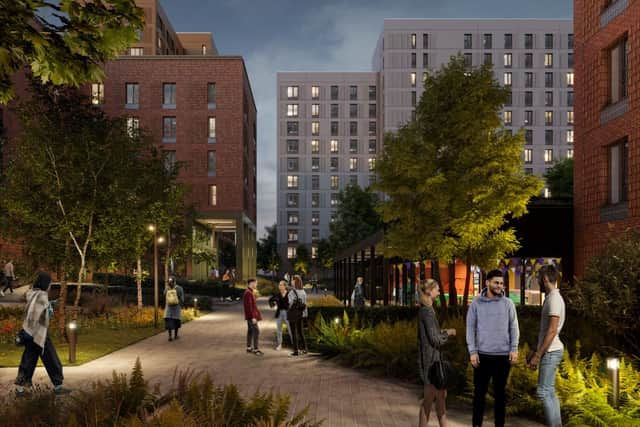

They argue current accommodation, largely built in the 1950s and 60s ‘is now reaching the end of its functional life’ and needs razing.
After the council granted outline planning permission, Owens Park Tower began to be torn down last year, bringing the 18-storey building’s 60-year tenure as a totem of south Manchester to an end.
Its disappearance prompted an outpouring of love from former residents, who include The Chemical Brothers, Rik Mayall, Benedict Cumberbatch and Jack Whitehall — with the latter saying it had ‘so many sordid memories’.
The Tower has been on borrowed time for years, with demolition approved in 2015 as part of a similar scheme to build smaller accommodation buildings.
A ‘village green’ would have replaced the 1965 modernist structure, complete with ‘chaise lounges’.
That vision was never fully realised, with only new Unsworth Park and Uttley House seeing the light of day. Both were built on vacant land behind existing halls so no demolitions took place.
But in the years since the 2015 plan fell through, more and more students moved from south Manchester to the city centre. In the four years since 2018, the number of students living in Fallowfield homes fell by a fifth.
The exodus prompted the council to ‘manage a pipeline of student accommodation’ in and around the city centre and university campuses, according to executive councillor for housing, Gavin White.
“As the city’s universities have consolidated their campuses towards the Oxford Road corridor, more students are choosing to live closer to their studies and the lure of city centre living,” he said in January.
“In fact, the number of students living in the city centre rose by 42pc between 2016 and 2022.
“We firmly believe that having world-renowned universities is good for the city, and these academic institutions also provide an engine of growth and job creation that helps Manchester to continue to thrive. This means working closely with those organisations to provide enough good quality accommodation to support the tens of thousands of students who choose Manchester as their next home.
“It is the role of the council to make sure that Manchester can react and adapt to different housing trends – and we are actively managing a pipeline of student accommodation schemes that have sufficient supply in the right locations to meet demand. Purpose Built Student Accommodation also provides a good alternative to mainstream city centre housing, helping to free up homes for our general population. Council tax from these homes can then also be received helping to fund the city’s essential services.”
One location students are flocking to is House of Social, just off First Street in town. The 576-bed, 14-storey private halls are grouped into clusters of two, five, or six bedrooms.
The ground and first floors are dedicated to a ‘food hall’ featuring five kitchens open to the public, in what a spokesperson for developer Vita said reflects students’ changing tastes.
They told the Local Democracy Reporting Service on a tour of the halls: “Students pay a lot more to come to uni. They have to come from reasonably wealthy backgrounds now so their expectations probably reflect that upbringing.”
With cushty accommodation available, which students seem to like — House of Social was ‘20pc let’ six months before opening — it can be tempting to assume Fallowfield’s days as the centre of Manchester’s student world are numbered.
However, the University believes Fallowfield remains ‘an extremely popular location for students’ as ‘nearly 43pc of applicants in 2021/22 selected it as their first preference’.
“Enhancing our accommodation offering here allows us to meet demand in a way that is sustainable and supports student safety, health and wellbeing,” a spokesperson added. “Students can access essential support services in a safe setting where a sense of community can develop while living amongst their peers.
“If the University is to effectively fulfil its obligations under the Accommodation Guarantee and support a reduced reliance on the mainstream housing market and houses of multiple occupation in the local area, there is a need to focus efforts on the Fallowfield campus where additional provision can have the greatest effect, given its popularity.”
Coun White also dismissed the idea, saying ‘it is unlikely we will see a complete end of students choosing to live there’, despite expecting ‘to see a trend of students moving towards the city centre’.