
‘Slowing drivers to 10mph’ solved city centre pollution – but taxi issues remain

Sweeping changes to Manchester city centre roads have worked to bring pollution down, transport bosses say — but air quality problems remain.
Council chiefs closed Bridge Street to cars heading out away from the city centre in late 2023, which meant motorists had to use parallel Quay Street to reach Salford’s inner ring road to leave town. It required slowing drivers down to ‘a maximum 10mph flow on local roads feeding into A34 Quay Street’ with speed bumps and one-way filters to combat air pollution in the area, one of Greater Manchester’s worst hotspots for nitrogen dioxide.
The region’s air was declared illegally dirty in 2017, leading ministers to direct Andy Burnham to reduce pollution ‘as quickly as possible’. An initial ‘clean air zone’ charging some drivers to use any Greater Manchester road, except motorways, was abandoned in 2022 after a huge backlash.
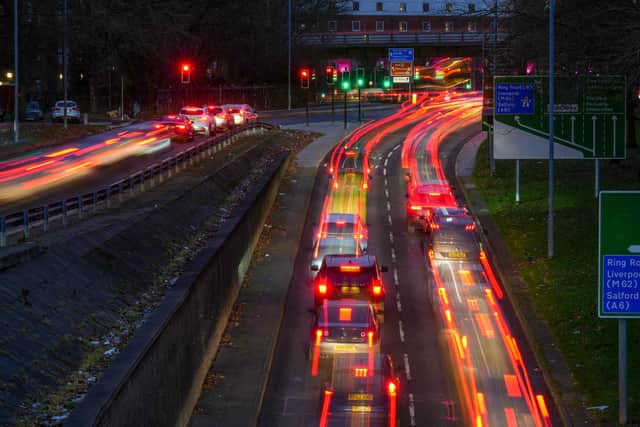

It was replaced with a non-charging clean air plan in late 2023, which called for a quick roll-out of electric buses and improving congestion on the A34 and A57 Regent Road to reduce pollution. Measures appear to have worked on Quay Street, Transport for Greater Manchester’s (TfGM) Megan Black said on Tuesday morning (February 3).
However, Manchester council is also struggling to get an £8m taxi upgrade programme off the ground. Just one-fifth of eligible Hackney carriages signed up in round one of funding, against a Greater Manchester average of 26pc, although its 115 applications out of 640 eligible drivers means Manchester had by far the largest number across the city-region.
That’s because every authority in Greater Manchester agreed to delay the compliance date until the end of 2026, and will allow non-compliant taxis to reach their maximum age, usually 15 years old, due to issues with sourcing new vehicles in time, Ms Black added at the environment scrutiny meeting.
She said: “For the support fund, all Greater Manchester authorities have changed licensing conditions and require, by the end of December, they meet air quality standards in the government framework.
“Authorities have taken onboard commentary from the industry on the cost of upgrading, on the age of the vehicle. It’s a choice between the economics of upgrading and the age of vehicle [left].”
However, although the latest data suggests Greater Manchester’s air has hit the legal limit on nitrogen dioxide of 40 micrograms per cubic metre of air (ug/m3), this is still far above the World Health Organisation guideline of 10ug/m3 — something executive councillor for transport Tracey Rawlins said leaders remain committed ‘working towards’.