
I created a major clothing brand for disabled people inspired by my grandfather

When Hanan Tantush, from Chester, saw her grandfather struggle to find a pair of trousers he could wear without pain, she realised something many of us take for granted: that for millions of disabled people, getting dressed isn’t about expression or style, it’s about comfort, dignity, and independence.
That moment became the spark that inspired Intotum, an adaptive fashion brand proving that “accessible” can also be beautiful.
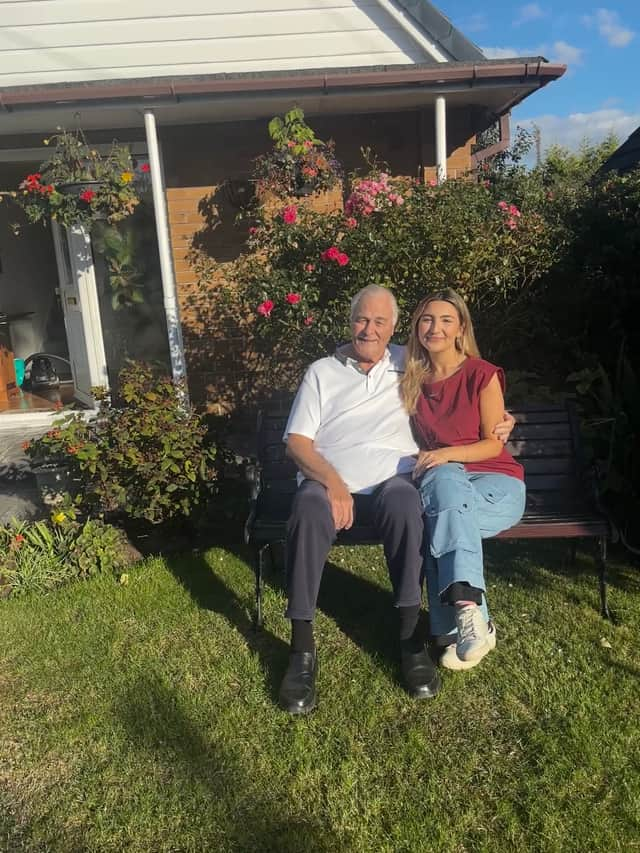
Hanan’s grandfather had always been the best-dressed man in the room. A former engineer in the Merchant Navy, he wore his uniform with pride and never lost that sense of presentation.


“Every memory I have of him is of him looking sharp. Trousers pressed, shirt tucked in, shoes polished,” Hanan recalls.
But after cancer surgery left him with a stoma placed high on his waistband, everything changed. “Every pair of trousers rubbed against it or pressed on the bag. The only thing he could wear without pain was jogging bottoms, and he hated how they looked,” says Hanan. “He stopped going out as much. He stopped being himself.”
Even his love of sport disappeared. “He’d often say how difficult it was to manage his stoma bag in public toilets, especially at football, and over time he stopped playing bowls for the same reason, something he’d done for 40 years. Seeing clothing strip away his confidence like that broke something in me.”
Hanan, now 23, quickly realised that what her grandfather was facing wasn’t unique; it was a systemic failure. “There is no real fashion for disabled people. There are clothes that cover your body, but not ones that let you express who you are,” she says.
The need for adaptive fashion has never been greater. Disabled people make up 24% of the UK population, yet fashion remains one of the least inclusive industries. With an ageing population, a rise in chronic illness, and more people living with disabilities than ever before, the gap between need and availability is widening fast.
In a UK survey, three-quarters (75%) of disabled people said mainstream fashion does not meet their needs, and many report that poorly designed clothing becomes a barrier rather than a support to daily life.
“Fashion has evolved to celebrate body diversity, gender fluidity, and sustainability, but disability is still treated as a niche,” says Hanan. “That invisibility is damaging. It sends the message that disabled people don’t belong in the conversation, or in the clothes.”
“When big brands launch ‘adaptive’ lines, they’re often just tracksuits in different colours. People tell me they want to feel stylish, to walk into a room and be seen for their outfit, not their condition,” Hanan explains. “But the industry still treats disability as a medical problem, not a human one.”
Changing rooms remain inaccessible. Magnetic fastenings are almost non-existent. Waistbands dig into stomas. Zips are placed where people can’t reach. As Hanan puts it, “Fashion, the very thing that should help us express who we are, has shut out an entire community.”
While studying at the London College of Fashion, Hanan began making adaptive pieces as part of her coursework, customising clothing for real people with disabilities. When she presented her designs, one comment stuck: “Disabled people don’t need fashion.”
“That sentence made me so angry,” she says. “And honestly, that anger built Intotum.”
She worked multiple jobs to fund her ideas, spent her retail wages on fabric, and entered every pitch competition she could find. Her determination paid off: she won £45,000 in startup funding, graduated with a First, and launched Intotum at London Fashion Week just six months later in February of 2024.
Two years on, Intotum has won more than 15 awards, been named in Drapers’ 30 Under 30, and built a community of over 10,000 people. But for Hanan, the real wins are quieter: “Messages from people saying it’s the first time they’ve dressed independently in years. That’s what success looks like.”
Every Intotum collection is co-designed by people with lived experience. Magnetic and Velcro fastenings replace buttons, inner pockets discreetly hold stoma bags, and seated cuts reduce pressure points for wheelchair users. The fabrics are sensory-friendly, seams are flat, and fastenings are quiet enough not to overstimulate.
“We don’t make adaptive clothing; we make adaptive fashion,” Hanan says. “Function, comfort, and style are non-negotiable. I would never design something I wouldn’t wear myself.”
The brand’s signature backless trench coat and velcro fastening trousers have become cult favourites. “One woman told me, ‘I want people to see me before they see the wheelchair,’” says Hanan. “I want people to feel empowered, not pitied. To dress without thinking twice about what they can or can’t wear.”
Her grandfather, who once avoided leaving the house, now proudly carries her business cards in his wallet. “He tells everyone about my business. He knows he inspired it all,” she smiles.
Looking ahead, Hanan plans to expand into denim, which will launch in 2026, and eventually into sportswear, with a future goal to make Intotum available in-store so disabled people can finally enjoy an accessible shopping experience.
“Disabled people go to work, go on dates, go on holiday, they deserve clothing that works for every part of their life,” she says. “Fashion has always claimed to be for everyone. It’s time it proved it.”
Launching on 7th November, Intotum’s latest collection reimagines what professional dressing looks like for disabled people. Designed in collaboration with wheelchair users, prosthetic wearers, and people with limited dexterity, the range introduces adaptive officewear that combines polish with practicality.
“We kept hearing the same story,” says Hanan. “People told us they avoided job interviews or office environments because they couldn’t find smart clothing that worked for them. That’s not just a fashion problem, that’s a barrier to opportunity.”
The new collection aims to remove that barrier, proving that inclusivity can sit right alongside confidence and style.