
Manchester wants to ‘at least half’ fly-tipping by raking through bins, closing alleys, and using cats

Manchester has declared war on fly-tipping as city leaders hope to ‘at least halve’ the practice in the next 10 years.
Council bosses want to see a huge drop-off in fly-tipping under a new strategy set to be approved on Wednesday (February 11). The town hall recorded 14,963 incidents last year, with the problem worsening in more than half of the city.
Buoyed by receiving £94m extra from the government this year, Manchester council is now promising action to clean up streets dirtied by ‘a small minority of the public’.
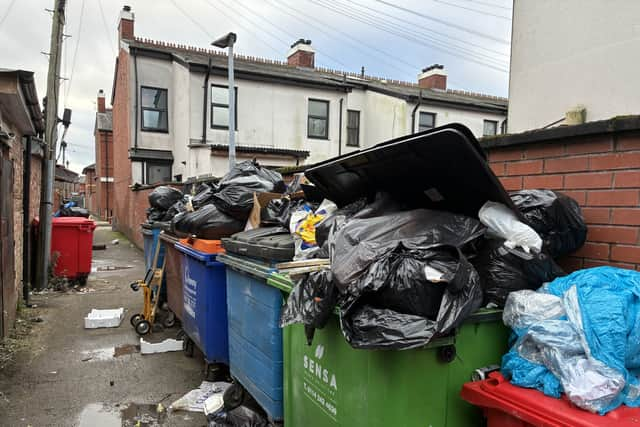

“This is a problem we are facing for the city,” Lee-Ann Igbon, executive councillor for vibrant neighbourhoods, told the Local Democracy Reporting Service on Tuesday (February 10).
“We had 350 investigations every month, which is a lot. It’s a lot of resources and a lot of money spent taking the rubbish and dealing with cases through the legal framework.”
Coun Igbon wants fly-tipping ‘to be as low as possible’ but said ‘at least half’ is what she has in mind ‘optimistically’.
“It’s a 10-year plan, it will take a long time to get out there and educate and engage residents and businesses to help us,” she added. “It’s not just a Manchester city council problem, it’s everybody’s problem.”
Teams were out in force around Claremont Road in Moss Side, where the LDRS joined operations to see how repeat offenders are caught. After tearing open several bin bags and picking through rubbish by hand, staff found a letter sent by Manchester council to a nearby address, suggesting that’s where the waste came from.
They can expect a letter from the council and potentially a fine, according to James Doherty from the compliance team.
He said: “If we found evidence, we’d contact you, we’d write to you under the Police and Crime Evidence Act. Depending on the circumstances, we’d look at prosecution or a fixed penalty notice, or a notice in general.
“Depending on the outcome of that, it could be referred to our legal services and potentially be heard in Magistrates’ court or through the Single Justice Procedure, depending on the severity and volume.”
But those prosecuted for fly-tipping might not be dumping amid a surge in cases from rogue ‘man with van’ operations.
“Make sure anyone you do get to get your waste removed, make sure they have a waste carriers’ licence,” James advised. “You can do that by going on the Environment Agency website.
“If they are not on there, please don’t use them because your waste is going to end up being fly-tipped. Be vigilant.
“If they do have a waste carriers’ licence, take details like name and address to cover yourself. If we do find evidence, we tend to go for the person in the evidence.”
Although the problem got worse in 18 of Manchester’s 32 wards last year, there is evidence the council can intervene to ‘design out’ fly-tipping, for example introducing alleyway gates. In Moss Side, after gates were installed on the Princess Road-Hartington Street ginnel, the council helped transform it into a cafe, play area, and eventually a home for the neighbourhood cats.
“People would come here, use the space, enjoy the space, and meet their neighbours,” council project manager Emma Krijnen Kemp explained. “The off-shoot of that was they would keep it clean, especially with us coming back week after week, people were motivated not to put rubbish out.
“We also noticed there were loads and loads of cats so we worked with local charities to get them re-homed and we’ve worked with residents to look after those cats.”
Cleaning up your neighbourhood’s alleys is something that needs neighbours to pitch in and help with, Anne Tucker, from community group Upping It, said. She explained how to get started: “Talk to us if you want, we can come over and suggest the best way to do it.
“Our rule of thumb is having a conversation with as many people as you can to start with. Then go around and put a leaflet through everyone’s door with a date for a clean up, or ideally knock on every door.
“Lots will say they can’t help but want it done. Other people will say they can help make cups of tea.
“A lot of alleyways don’t have gates on, but it doesn’t seem to make much difference.
“We can provide brushes, brooms, and bins, and other things to sort out the rubbish. After that, we discuss what they want to do with the space.”