
'It was as rough as a bear’s a**e' - we visit Ancoats to find out how much it has changed in 20 years
Flicking through Google Streetview shows just how much Ancoats has changed in the last 20 years.
In Ancoats, what was once wasteland, unloved canals, and the Cardroom housing estate is now home to wine bars, narrowboat living, trendy young professionals, and plenty of pint-sized pets.
It’s a similar story in Broughton, where family housing and flats replaced warehouses, as a new generation of Salfordians settle down in the area that’s just a short walk from Manchester city centre.
As the areas changed, questions over who benefits from redevelopment have lingered as construction of affordable homes remained low.
Now, both neighbourhoods have been listed as among the ‘10 most gentrified parts of Greater Manchester’ in a new study. It defined gentrification as disadvantaged families moving out of one area and being replaced by wealthier residents in a short time.
The study from think tank Common Wealth measured ‘population churn, the change in the proportion of non-white residents, median house price growth, the difference in deprivation between [an area] and those migrating to it, and average wage growth’ from 2012 to 2023.
Ancoats was fourth-most-gentrified with a score of 67.7, and Broughton was eighth with 50.4, but parts of both areas hit 100 and 82 respectively.
“While increases in indicators like wages and house prices may be seen as markers of growth and beneficial to the development of Manchester as a regional hub, our analysis shows that this growth has come at the cost of displacing former residents in these inner-city areas,” said report co-author Sophie Flinders.
“This profit-driven model of growth pursued by the Greater Manchester Combined Authority benefits a select few: international capital-backed developers, whose business model is only possible by driving up rents in the inner city, and high-income earners who can afford the rent on new luxury developments.”
To understand how the redevelopment of Ancoats and Broughton has impacted residents, the Local Democracy Reporting Service spoke to new and longstanding locals in both suburbs.
“It was as rough as a bear’s a**e”
Neil Tate has lived near New Islington Marina — often cited as the symbol of Manchester’s recovery from post-industrial collapse — since 1990. The 76-year-old has seen the area ‘change completely’.


“It was rough as a bear’s arse when I moved here,” he explained on a frigid February lunchtime. “If you parked your car, your wheels would go.”
Gesturing to the marina, he continued: “Where all this used to be there was the Cardroom estate, there were drugs and fire engines putting out cars on fire. But the prices now are horrendous.”
Five years after Neil moved in, the average house price in Ancoats was £18,000. By 2012, it was £125,000. Now, it’s £294,000 — 16 times higher.
Neil isn’t a fan of the changes, describing Ancoats as ‘a concrete jungle’ and ‘awful’.
“I’ve never seen so many people,” he added. “I’ve never seen so many dogs, I think they must get lonely in their flats.”
Norwegian Asle Frydenlund is also not a fan. The 70-year-old moved into Flint Glass Wharf, just behind the beating heart of Ancoats — Cutting Room Square — in 2010. He left for Beswick three years later.

“At that time there was nothing,” he remembered. “There was a gap and nothing else. There were some people, kids, and beautiful open space.
“I hoped that over time they would use the green to build a green lung [for Manchester]. But it has become a concrete jungle.”
Asle would have stayed longer ‘if they had done something more with the canals and used the opportunity to have a green lung’. Now, he thinks people only move to M4 for ‘the few square metres of grass and the ducks and the boat life’.
His view that Ancoats’ attraction is a small vignette of greenery and quirky aquatic living is shared by Owain Williams, 24, who called the area a ‘playground of the middle classes’. Owain lives in Withington but works in Ancoats, and says he has ‘colleagues from Ancoats but they do not live here because they cannot afford it’.
“If I was young, free and single I would be here”
But there are big fans of Ancoats, including the married couple, the Bodes from Stockport.
“I think it’s amazing,” said wife Maureen, 69. “It’s developing all the time.
“It feels almost like you’re in the countryside, it’s very European. If I was young, free and single I would be living here. There’s a mix of older and new, it’s been done in a nice way.”
Husband Larry, 76, recalled his first interaction with Ancoats: “It was a bomb site in the 50s. I cannot equate the appearance then compared to now. I thought all of Manchester looked like that.”
Another fan is Rhiannon McGoldrick, 31. Originally from Leeds, she moved up from London as ‘it was recommended as a place close to town and nice and chilled’.
Her first Mancunian home is ‘pretty quiet compared to anywhere else this close to town’, but she has worries about its future. She added: “We have a good deal here with rent. But everything is shooting up all around us.”
“You hear more southern accents”
Broughton hasn’t attracted the same attention Ancoats has in the gentrification debate. But its eighth place ranking on the index underlines how much this corner of Salford has changed.
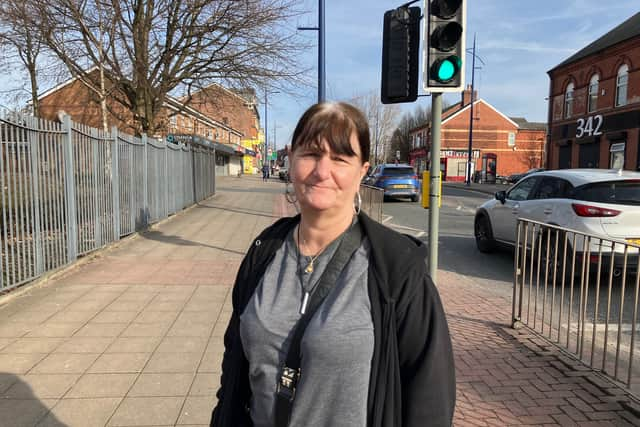
Ruth Tansey, 58, moved to Broughton when she was 15 and has lived there ever since. The transformation hasn’t been a good thing, she thinks.
“The whole place is changing, I think it’s going downhill,” she explained. “It’s overcrowded, there are too many cars on the roads, there’s so much traffic.
“I see the prices in all the shops going up, houses are getting more expensive. Some people are having to rob or shoplift because they just can’t afford to live. But we’ve also got problems with shops closing, homelessness and people on the streets. Things are changing and it’s made life harder for us.”
Cost-of-living worries are at the forefront of June’s mind. The 41-year-old said: “It’s getting much more expensive, it used to be a lot cheaper. Some people can’t afford to pay the rent anymore.
“More people are coming because it’s so close to town, Prestwich is also not far. They’re building new houses all the time and more people are coming here, they’re building out further and people are moving into these areas now.”
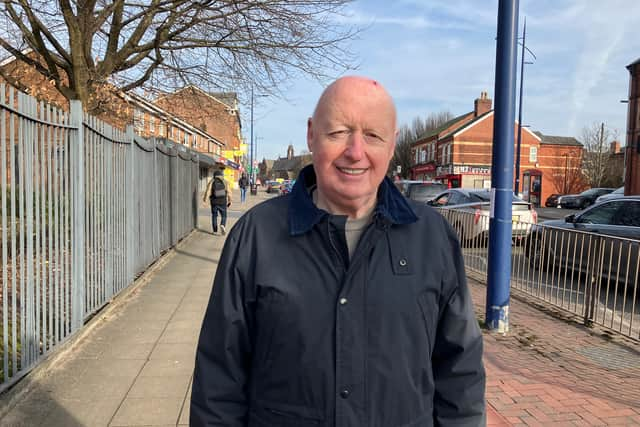
House prices in Broughton rose from £19,400 30 years ago, to £25,463 in 2012, and it’s £263,000 currently. But making rent is a worry here too.
Jimmy Gage, a retired police officer from Northern Ireland, moved to the area in 2002 after meeting his now wife on a holiday in Spain. He’s noticed house prices shoot up lately. “There was one that I know of, a three-bedroom house, which was rented out for £1,300 a month in Broughton. I think the changes are a bad thing overall,” he said.

But Kyle Richardson, 34, who moved in seven years ago after finishing his studies at the University of Manchester, said he loves living in the area despite ‘things getting pricier.’
He said: “My rent has just gone up by £200. I think it’s the location, a lot of new developments are coming here.
“You also hear more southern accents now, people from places like London moving to Broughton who are maybe working in Manchester. People coming here see the house prices and think it’s not bad.
“It’s hard to say if these changes are a bad thing or not. I think there are people in secure well-paying jobs who are benefiting, but there are others from working class communities who are struggling.”
The Greater Manchester Combined Authority was contacted for comment.