
Fly-tipping capital of Manchester named as new map exposes city’s dirtiest areas

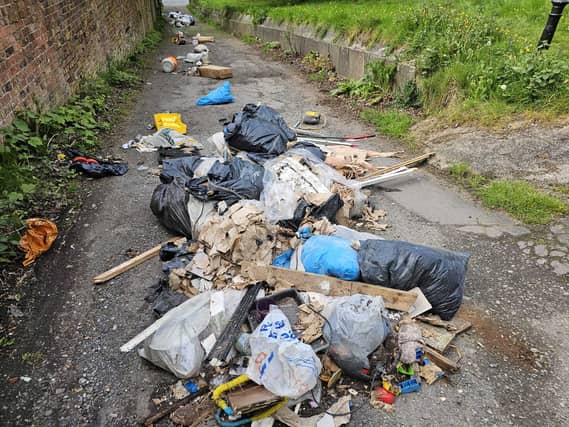

Manchester’s fly tipping hotspots have been named by a new study that shows big increases in illegal dumps in the worst neighbourhoods.
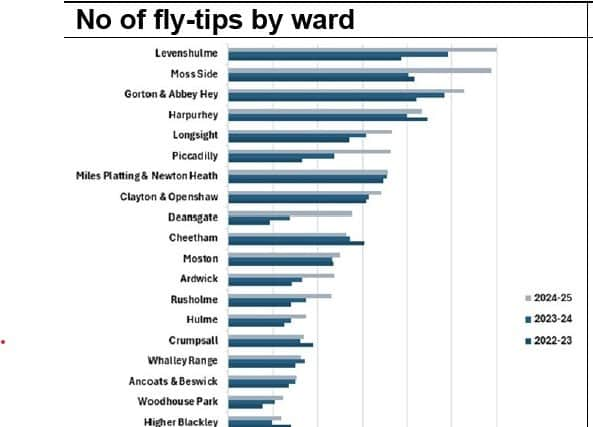
Data released in a town hall report shows fly tipping rose in 18 of the council’s 32 wards from 2023/24 to 2024/25, with the three neighbourhoods most blighted by the issue seeing big jumps.
Levenshulme was named as the fly tipping capital of Manchester, and although exact figures have not been given in the authority’s study, graphs show it saw around 3,000 fly tipping incidents last year. That represents a year-on-year increase of more than 500.

Moss Side came second, with nearly 3,000 reports, another rise of more than 500. Third was the Gorton & Abbey Hey ward, where just over 2,500 fly tips were made, a surge of more than 100.
The areas least affected were East Didsbury, Chorlton, and West Didsbury, where well under 500 incidents were recorded in the year.
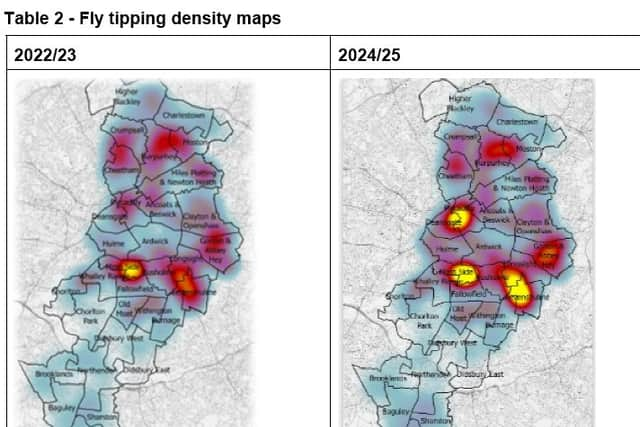
Town hall chiefs say in the study fly tipping is more prevalent in wards with more passageways, with the worst three areas of Levenshulme, Moss Side, and Gorton & Abbey Hey containing one-third of the city’s alleys, where 60pc of fly tips end up.
“Passageways are hotspots: 60pc of reports are in top wards; targeted clearance and campaigns are in place,” the report to the council’s environment scrutiny said.
It added other challenges in solving the problem include ‘mismanaged domestic waste’ and ‘enforcement challenges.
Across the city, ‘entrenched behaviours, low reporting in some neighbourhoods, and transient populations can impact progress’ in tackling the problem, but ‘in some places, there is a need for increased ownership and responsibility among residents’, the report went on.
The statistics cover a period which ended in April, a month after the council formally declared ‘war on rubbish’.
“Despite the vital work of community groups and council services cleaning our streets, now is the time to step up the fight to clean our streets,” its motion approved in March said. “From litter thoughtlessly dropped, to repeat rogue landlords and businesses dumping their rubbish on our streets — enough is enough.
“Together we will win the war on rubbish and clean up our streets.”
On-the-spot littering fines rose from £150 to £180 in the wake of the declaration, and councillors argued more money should also be invested to ‘increase the capacity of the team that handles investigations and issues fines’ and ‘expand CCTV for the worst offending areas’ and ‘looking at how we can use new technology to roll out cameras and enforcement in [fly tipping] hotspots’.
The council’s 2025/26 budget also included £4.6m for extra street cleaning and improving green spaces.
“Residents told us loud and clear in our recent budget consultation that keeping neighbourhoods clean was their top priority and we have responded to that with this extra investment,” Councillor Rabnawaz Akbar, executive member for finance, said. “We are pleased to be in a position where we can deliver a budget that works for Manchester people.”