
Bee Bread, Spiders and the Future of Net Zero Flights
Latest student science discoveries unveiled at IRIS science conference in Manchester
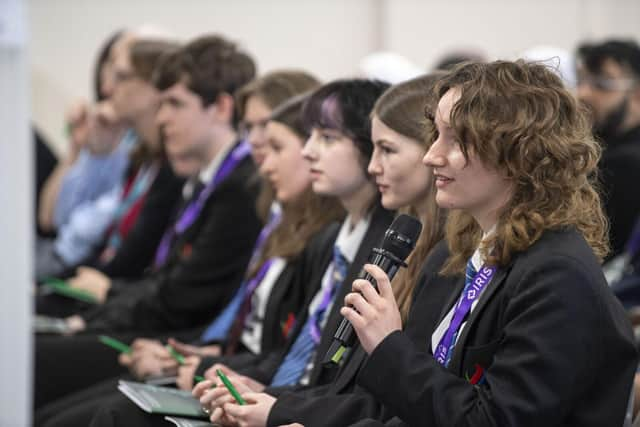
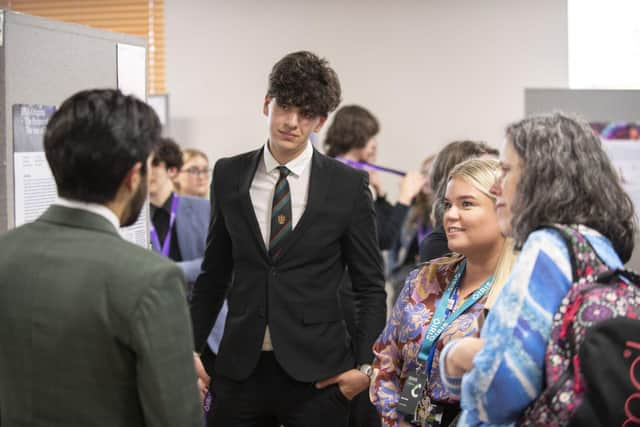
Young scientists presented their findings and research today from a number of real scientific research projects, at this year’s Institute for Research in Schools (IRIS) conferences.
The Institute for Research in Schools (IRIS) aims to change the culture in UK education to make authentic research part of every young person’s science experience and nearly 2,000 students have taken part in projects supported by IRIS this year.
Some of the research highlights from the IRIS Student Conferences 2024 unveiled in Manchester today, to a panel of eminent scientists and industry experts this year were:

-
Analysing bee food to understand where bees feed
-
Why spiders can climb walls
-
Understanding a school’s ecosystem to reduce pollution
-
Modelling hydrogen fuel cells on planes
-
If heat protectant products really work on heat-straightened hair
Dr Jo Foster, Director, Institute for Research in Schools said: “Once again we’ve all been so impressed by the high standard and quality of the real-world research carried out by all the young scientists. We love seeing that spark of interest light up in students as they explain how they made their fascinating discoveries. The work they do is genuinely valuable and in many cases helps real scientists in their current research. The whole experience can often lead to a fantastic career in science at a time when we have so many vacancies in the UK in science and technology.”
Dame Kate Bingham DBE, Patron, Institute for Research in Schools said: “It’s great to see students’ genuine interest in their research. Their ability to talk about their work so knowledgeably and passionately is impressive and I’m keen to see how these young scientists develop.”
Professor Alan Barr, Professor of Particle Physics, Oxford University said: “These students are doing really well-motivated work, using advanced and appropriate methods and tools, most familiar only to those at graduate level.”
-
Liverpool Life Sciences UTC analysed the pollen in ‘bee bread’, so-called food that bees feed on over winter. Using a SEM (Scanning Electron Microscope) students looked at which pollens were found in their food, in order to work out which flowers bees tended to feed on. A separate group of students at Liverpool Life Sciences also looked at how spiders walk up walls, using a SEM.
-
St Wilfrid's Catholic High School and Sixth Form College students have improved biodiversity at their school, mapping their trees to understand their ecosystem benefits, installing ‘living walls’ in the school’s car park and are building an environmental monitoring device.
-
Keswick School students looked at the validity of heat protectant and its use when straightening hair
-
Bilborough College students are designing planes of the future, modelling ways to adapt passenger planes to utilise hydrogen fuel cells.
-
St Mary’s Catholic school tasked themselves with ‘cosmic mining’, which is investigating satellite data to explore the stars forming and fading in our galaxy
All these students and more showcased their findings to their peers and the wider scientific community, including Professor Alan Barr, Professor of Particle Physics at Oxford University, Dr Saleha Patel Associate Principal Scientist and lead drug discoverer from AstraZeneca and Harrison Dance, Mechanical Design Engineer for ZeroAvia.